Back to Feed
Renaissance · Rome, Italy
Infinite Worlds: The Philosopher Burned for Imagining the Cosmos We Now Know Exists
★ 8.8 / 10science vs religioncosmologyInquisitionmartyrdom
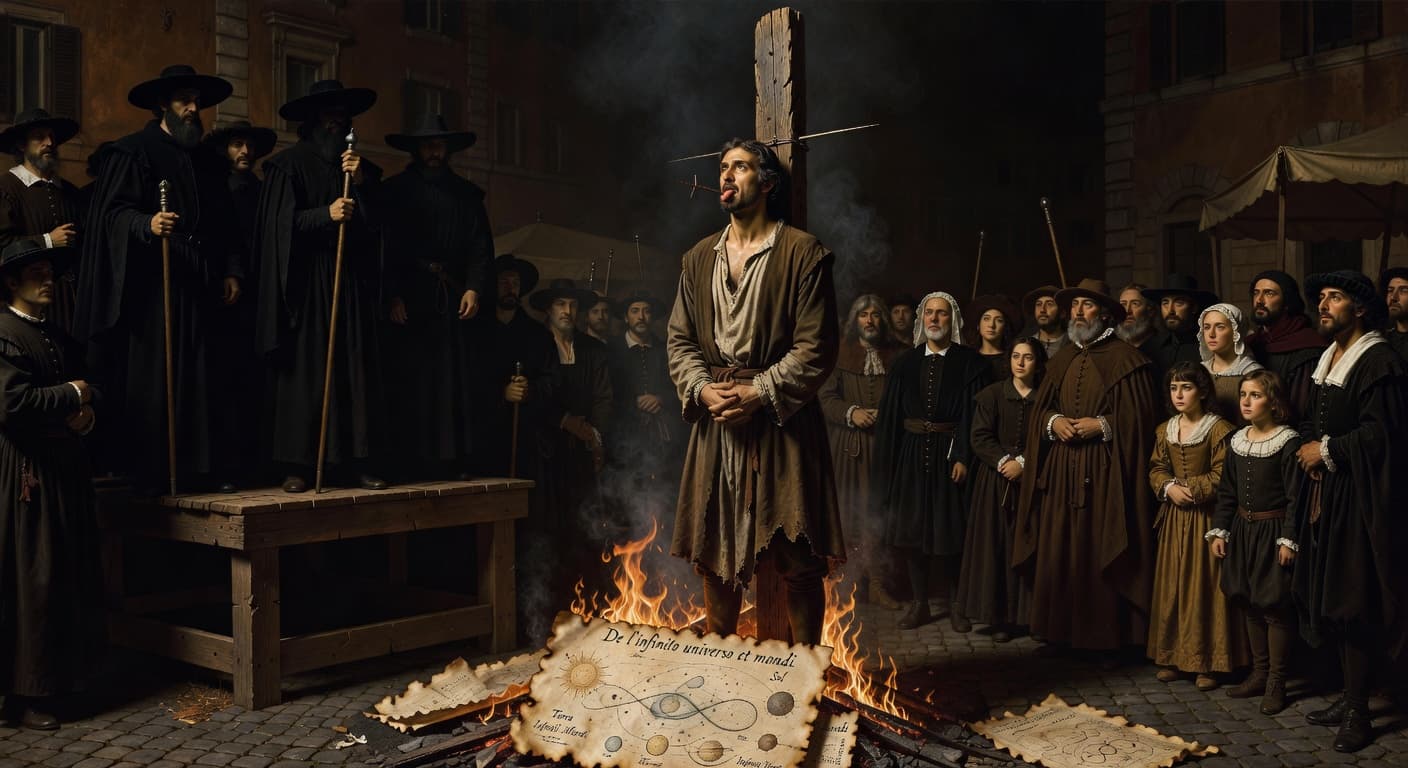
On February 17, 1600, Giordano Bruno was led into Rome's Campo de' Fiori with an iron spike through his tongue so he could not address the crowd. He was stripped, bound to a stake, and burned alive. Bruno had spent the previous seven years in the dungeons of the Roman Inquisition, refusing to recant. Born in 1548 in Nola near Naples, he had spent decades wandering Europe — Geneva, Paris, London, Prague, Frankfurt — lecturing and publishing books that made theologians furious everywhere he went. When a Venetian nobleman lured him back to Italy with promises of safe employment in 1591, the Inquisition had him arrested within a year. What Bruno actually argued went far beyond anything Copernicus had claimed. Copernicus said Earth orbited the Sun; Bruno said the Sun was just one star among an infinite number, each surrounded by planets of their own. He argued these other worlds were inhabited. He argued the universe had no center and no edge. He derived these cosmological positions partly from religious reasoning — an infinite God must create an infinite cosmos — and partly from Hermetic philosophy. The Inquisition condemned him on ten specific propositions, among them his insistence on "many worlds, many suns, necessarily containing similar things in kind and in species as in this world, and even men." He was not burned purely for cosmology. His list of heresies also included denial of the Trinity, denial of the virgin birth, denial of transubstantiation, and the belief that all souls migrate eventually back into God. But the Inquisition's own documents confirm that his cosmological claims — the multiplicity of inhabited worlds — were central to the case. Every exoplanet discovered since 1995 has confirmed Bruno's intuition. A statue stands in the Campo de' Fiori where he burned, erected in 1889 by Italian freethinkers who made him a martyr of science and reason against Church authority.
Score Dimensions
Original Source
wikipedia.orgLike
Dislike
Skip
Save