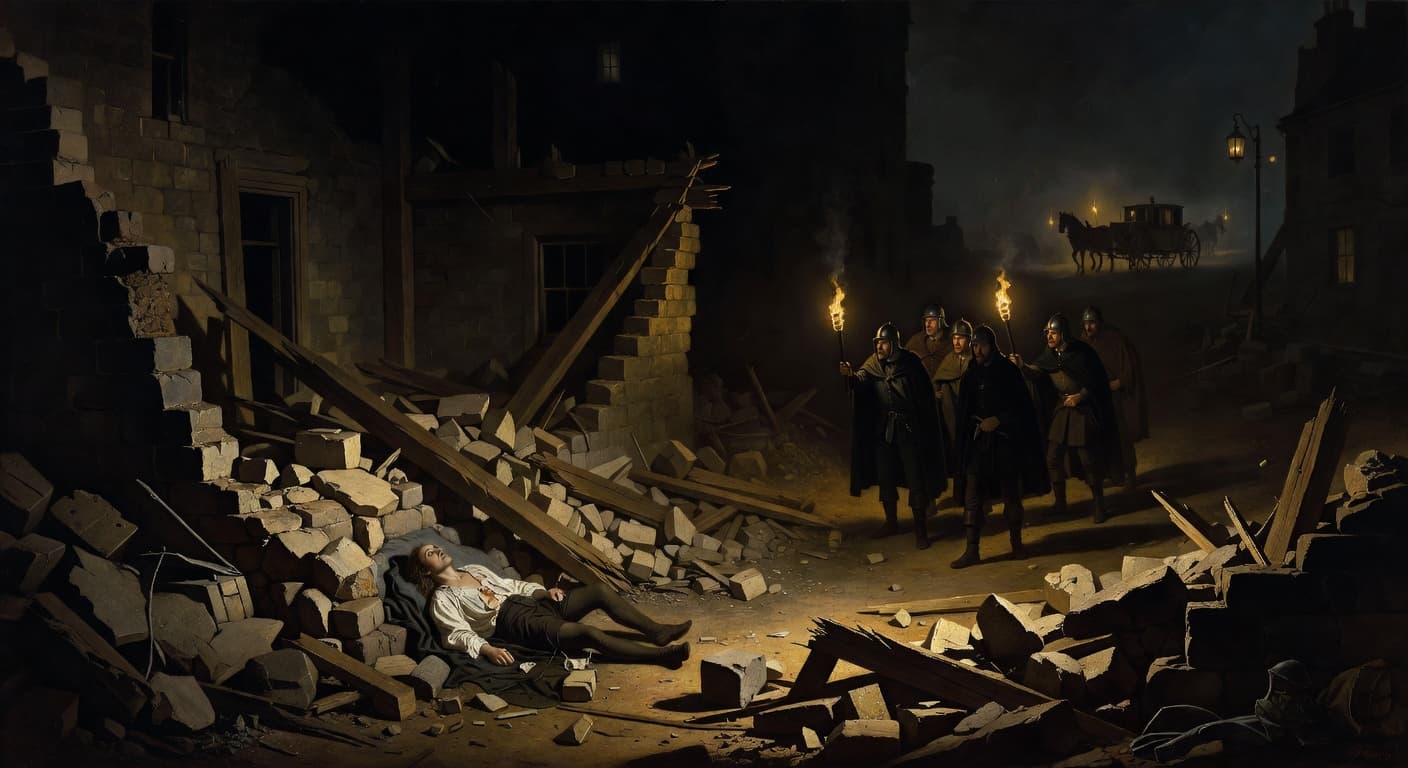
At two o'clock in the morning of February 10, 1567, an explosion of catastrophic force destroyed the townhouse known as Kirk o' Field, just outside Edinburgh's city walls. The blast was heard across the city. When investigators arrived at first light, the bodies of Lord Darnley — Mary Queen of Scots' second husband — and his valet William Taylor were found in a nearby orchard. They had not been killed by the explosion. They were dressed only in nightshirts, having apparently fled through a window. Both had been strangled.
Darnley had been recovering from syphilis at Kirk o' Field when two barrels of gunpowder were placed in the cellar beneath his sleeping chamber. Whoever placed them clearly expected the explosion to kill him. When he somehow escaped the blast — perhaps warned, perhaps woken by noise — someone was waiting in the orchard. The identity of that someone has been disputed for four and a half centuries. The shoes of Archibald Douglas, a supporter of James Hepburn, 4th Earl of Bothwell, were found at the scene. Within weeks, Bothwell was universally believed to be the architect of the murder. He demanded a trial, was acquitted after a seven-hour hearing in which no evidence was presented (his armed supporters surrounded the building), and then circulated a bond signed by two dozen Scottish lords agreeing he should marry the queen.
Three months after the murder, Mary married Bothwell. The marriage destroyed her. Protestant lords united against her, captured her army at Carberry Hill in June 1567, imprisoned her at Lochleven Castle, and forced her to abdicate in favor of her thirteen-month-old son James. Bothwell fled to Scandinavia where he was eventually imprisoned by the King of Denmark, chained to a post too short to stand at, and left until he died mad ten years later.
Mary's guilt in Darnley's murder turns on the "Casket Letters" — eight letters and sonnets allegedly written by Mary to Bothwell before the murder, implying her foreknowledge. Mary denied writing them and called them forgeries. Her son James VI, who had every political reason to suppress evidence of his mother's guilt, reportedly destroyed the originals in 1584. The mystery remains mathematically unsolvable: either Mary conspired in her husband's murder and married his killer, or her enemies forged the most consequential letters in Scottish history.