Back to Feed
Medieval · England
The King Who Abandoned His Pregnant Queen to Save His Favorite
★ 8.9 / 10medieval EnglandLGBTQ historyPlantagenet dynastycourt favorites
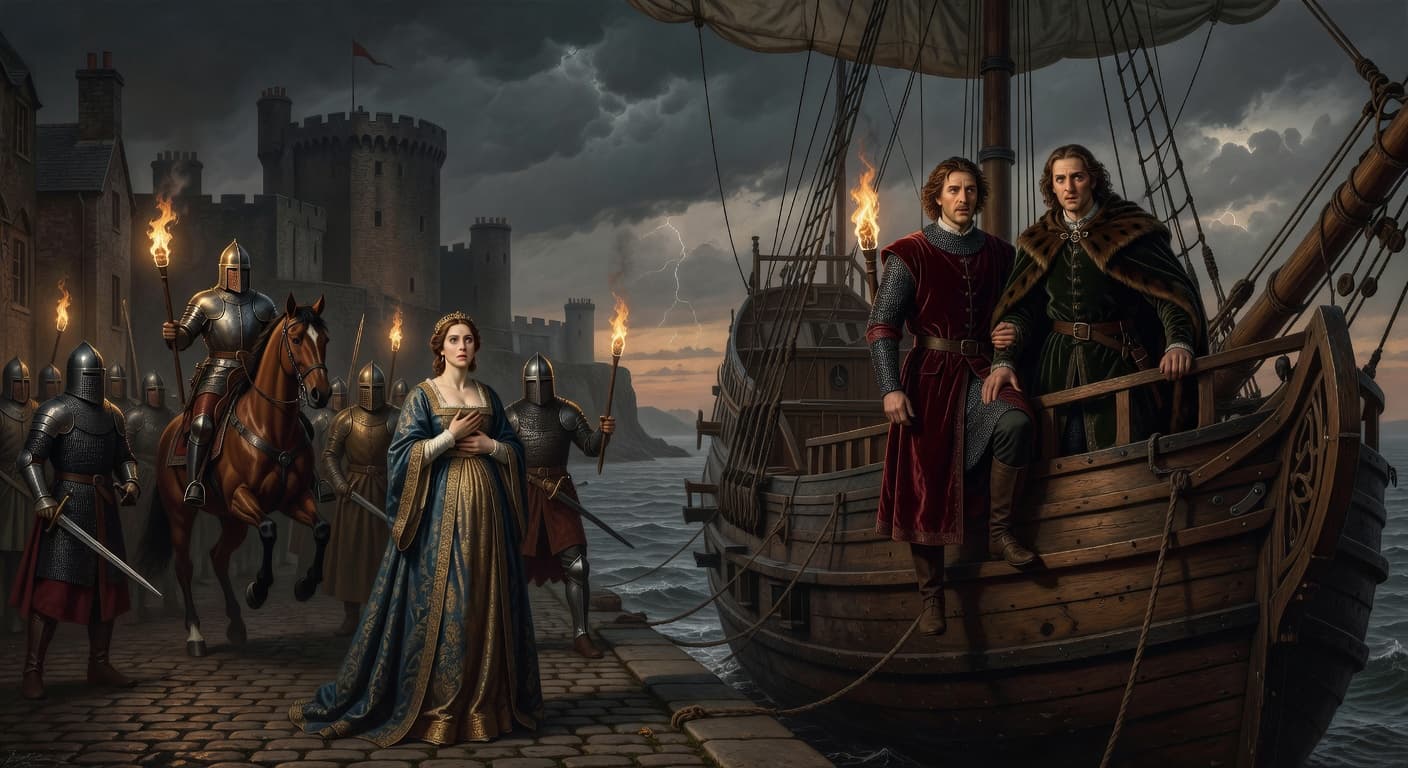
When the barons of England rose against King Edward II in 1312, he fled north from York with his court and his beloved Piers Gaveston, Earl of Cornwall — the Gascon knight who had been his constant companion since boyhood. The baronial forces were closing in. At Newcastle, facing imminent capture, Edward made a choice that contemporaries found almost impossible to comprehend: he abandoned his baggage train, his royal treasury, his horses, his jewels, and his five-months-pregnant wife Queen Isabella of France. He escaped by sea. Gaveston surrendered to the Earl of Pembroke, was seized by the Earl of Warwick, tried in summary proceedings, and beheaded on Blacklow Hill on June 19, 1312. The relationship between Edward and Gaveston had destabilized England for the full first decade of Edward's reign. When Edward I lay dying, his last act was to exile Gaveston — to whom his son had apparently been attached since Gaveston joined the royal household as a teenager. The moment the old king died, Edward recalled Gaveston and signed his very first royal charter: granting Gaveston the Earldom of Cornwall, one of the greatest titles in England. At his coronation in 1308, Edward paid so much attention to Gaveston that Queen Isabella's French relatives walked out of the banquet in fury. The precise nature of the relationship is disputed. A medieval chronicle states that upon seeing Gaveston, the young Edward "felt such love for him that he tied himself to him against all mortals with an indissoluble bond of love." Pierre Chaplais argued in 1994 that they had entered into a formal bond of sworn brotherhood. Most historians now consider a romantic or sexual relationship likely. What is certain is the political consequence: Gaveston wielded such influence that one chronicle complained there were "two kings reigning in one kingdom, the one in name and the other in deed." Edward never forgave his barons for Gaveston's murder. For the next decade he worked systematically to destroy the men of the Blacklow earls, achieving his revenge in 1322. Gaveston's body was given a state burial at King's Langley, at Edward's personal expense, with honors fit for royalty. The king who had abandoned a pregnant queen in the night to save a man he loved gave that man, in death, the ceremony he had never been permitted to show in life.
Score Dimensions
Original Source
wikipedia.orgLike
Dislike
Skip
Save