Back to Feed
Medieval · Languedoc, France
Kill Them All: The Papal Crusade That Burned an Entire Civilization
★ 8.9 / 10religious persecutioncrusadesmedieval Francegenocide
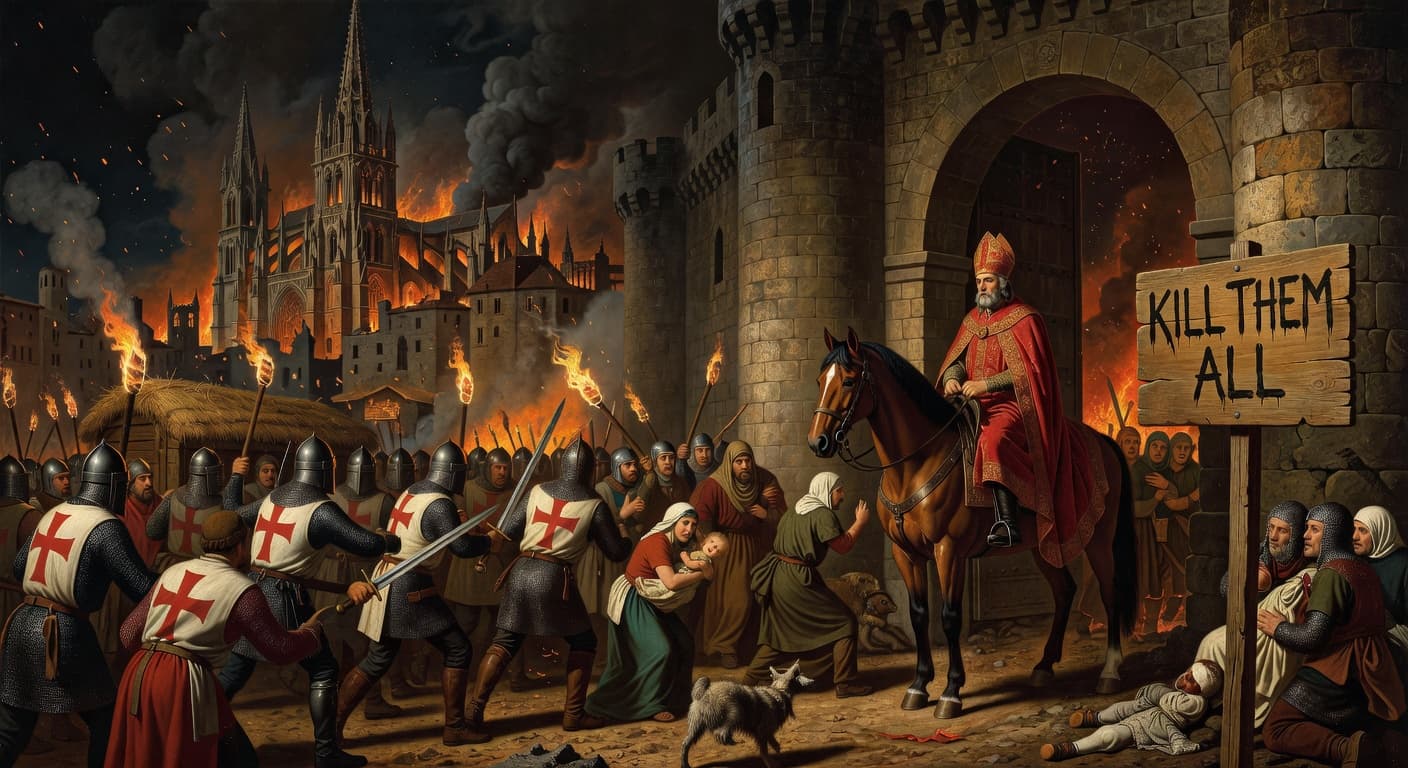
On July 22, 1209, the crusading army of Pope Innocent III reached the walls of Béziers in southern France. The Bishop of Béziers had negotiated a deal: hand over 222 named Cathars and the city would be spared. The citizens refused — the heretics had too much community support. After a botched sortie by the city's defenders, the crusaders flooded through the gates. According to the Cistercian writer Caesar of Heisterbach, when the papal legate Arnaud Amalric was asked how soldiers should distinguish Cathars from Catholics, he replied: "Caedite eos! Novit enim Dominus qui sunt eius" — Kill them all! God will know his own. Amalric himself wrote to the Pope that approximately 20,000 people were put to the sword. The city burned. Béziers lay in ruins for 300 years. The Cathars were a dualist religious movement that had flourished across Languedoc for over a century. They believed the material world was the creation of an evil god and the spirit was trapped within it — making the entire institutional Church, which accumulated land and wealth, a kind of diabolical enterprise. Their perfecti lived in genuine poverty and abstinence while the Catholic clergy grew rich. This contrast had won them enormous popular support across the cities and nobility of southern France. Pope Innocent III had tried diplomacy for years. After his legate Pierre de Castelnau was murdered in 1208 — the Count of Toulouse was suspected — Innocent declared a crusade and offered the lands of Cathar heretics to any French nobleman willing to fight. The crusade lasted 20 years. At the siege of Minerve in 1210, 140 perfecti who refused to recant were burned alive. At Montségur in 1244, the last Cathar stronghold fell after a nine-month siege; more than 200 perfecti walked voluntarily into a bonfire rather than apostatize. The Inquisition, invented partly to hunt down survivors, required Cathar believers to inform on their neighbors. An estimated one million people died across the campaign. By 1300, an entire religious civilization — with its own bishops, theology, and social order — had been annihilated by a Church that found their critique too accurate to tolerate.
Score Dimensions
Original Source
wikipedia.orgLike
Dislike
Skip
Save