Back to Feed
Medieval · Europe
Medieval Plague Doctors: Useless Cures, Dead Chickens, and Drinking Urine
★ 8.1 / 10plaguemedicinemedievalblack-death
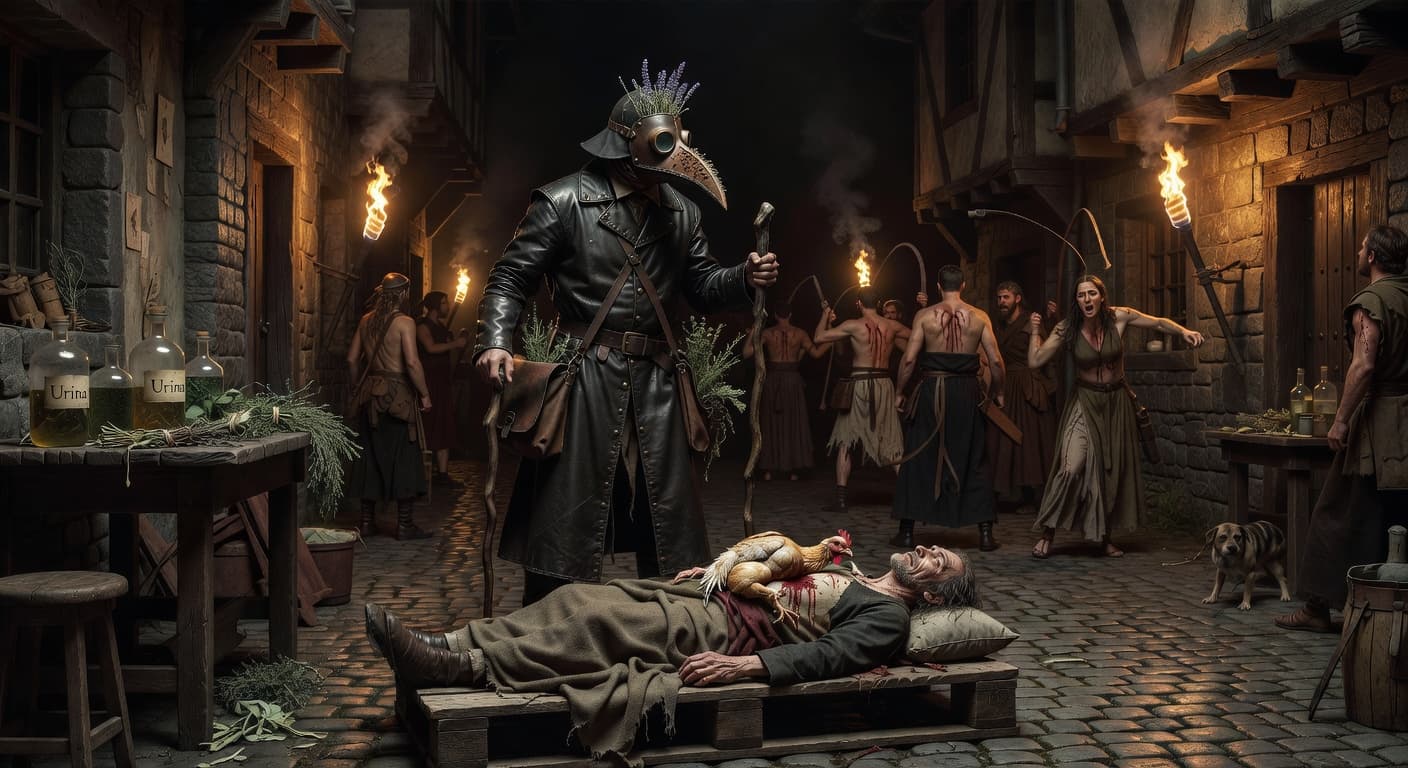
When the Black Death arrived in Europe in 1347, killing roughly a third of the continent's population, medicine had no tools to fight it. The cause — the bacterium Yersinia pestis, carried by fleas on rats — would not be identified for another 547 years. Plague doctors worked within a framework of medical theory inherited from ancient Greece: disease resulted from imbalances in the body's four "humors" — blood, phlegm, yellow bile, and black bile — and treatment meant correcting the imbalance. This led to an extraordinary range of interventions, almost none of which helped and several of which actively accelerated death. Bloodletting was the dominant treatment: puncture a vein and drain away the excess humor, ideally from the location closest to the afflicted area. The buboes — the swollen lymph nodes that are the disease's signature — were sometimes lanced and drained directly. Physicians placed live plucked chickens against the swellings, the idea being that the bird would draw the disease out through the skin, and continued replacing them as each bird sickened and died. Patients were prescribed drinks containing ground emeralds, powdered "unicorn horn" (almost certainly narwhal ivory), and in some formulations, mercury — a poison that killed faster than the plague. Poultices of human excrement mixed with other ingredients were applied to open sores. Patients were directed to drink their own urine, or bathe in it. Snakes were chopped and applied to the buboes. The iconic beaked-mask costume — the leather coat, crystal spectacles, staff for touching patients without contact — emerged in the seventeenth century, not during the medieval outbreak, and reflected the miasma theory: disease was carried in bad-smelling air, so the long beak was stuffed with aromatic herbs and vinegar-soaked sponges to filter it. The costume protected nothing, but the instinct toward isolation and non-contact was better medicine than anything being prescribed. What plague doctors actually provided was documentation. They counted the dead, recorded symptoms, witnessed wills and last testaments, and attempted autopsies. Of 18 physicians in Venice during the 1348 outbreak, only one was left by the end: five had died and twelve had fled. The accumulated records they left behind — far more valuable than their treatments — eventually led to quarantine protocols that would slowly, over generations, begin to limit the spread of epidemic disease.
Score Dimensions
Original Source
wikipedia.orgLike
Dislike
Skip
Save