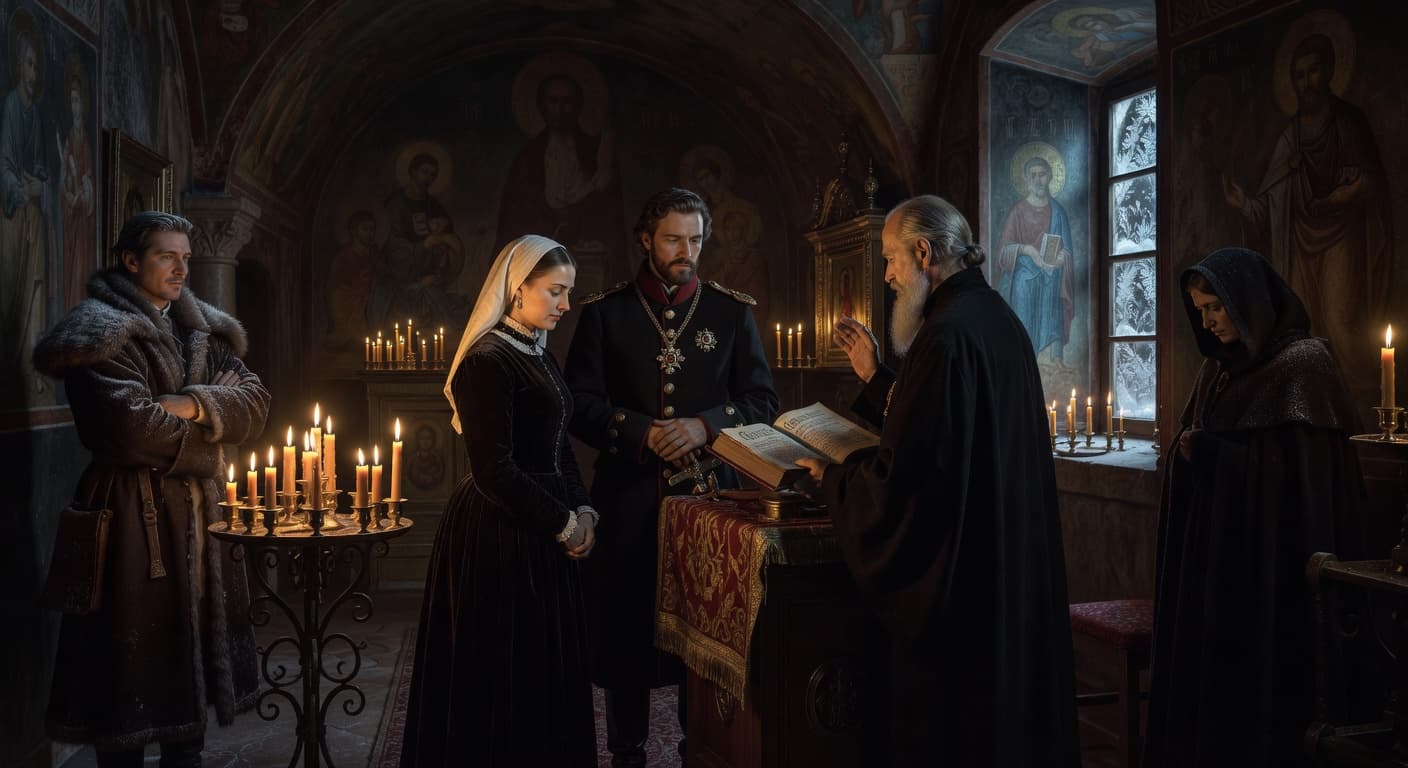
In the autumn of 1774 or early January 1775 — the exact date historians cannot confirm because the ceremony was deliberately left unrecorded — Catherine II of Russia almost certainly married Grigory Potemkin in a secret ceremony. The world's most powerful empress, who had seized the Russian throne in a coup twelve years earlier, could not publicly acknowledge the love of her life. A public husband would have required sharing power; a husband from Russia's minor nobility would have shredded her prestige. So they conducted a marriage that neither of them would ever officially admit to.
Potemkin had entered Catherine's orbit dramatically: brutally beaten and partially blinded by the giant brothers Grigory and Aleksei Orlov, rivals who feared his growing influence, he retreated into a monastery in despair. Catherine herself wrote him back into the world, showering him with posts that forced him out of seclusion. What followed was one of history's most extraordinary political partnerships. Potemkin vetted Catherine's subsequent lovers — a bizarre arrangement that had her future paramours writing to him as a father-in-law — while Potemkin's five famously beautiful nieces served as Catherine's ladies-in-waiting. The court at St. Petersburg was organized around the emotional architecture of a secret marriage that officially didn't exist.
The evidence for the marriage is circumstantial but compelling. A daughter, Elizaveta Grigorievna Temkina, was born July 24, 1775 — nine months after their supposed union. Potemkin died in the Bessarabian steppe in October 1791, clutching Catherine's letters in his hand. "A terrible, crushing blow struck me," Catherine wrote to Baron Grimm. "Nothing will ever be the same." She survived him by five years but never recovered from the loss.
What makes this scandal historically peculiar is not the relationship itself — monarchs routinely kept lovers — but its inversion of every norm. Here was a ruling empress who outlasted her husband in power, who chose her own lovers with imperial authority, yet who privately conducted a marriage she had to pretend never happened. The Romanov dynasty's survival depended on Catherine's image as an absolute sovereign. Love required camouflage.