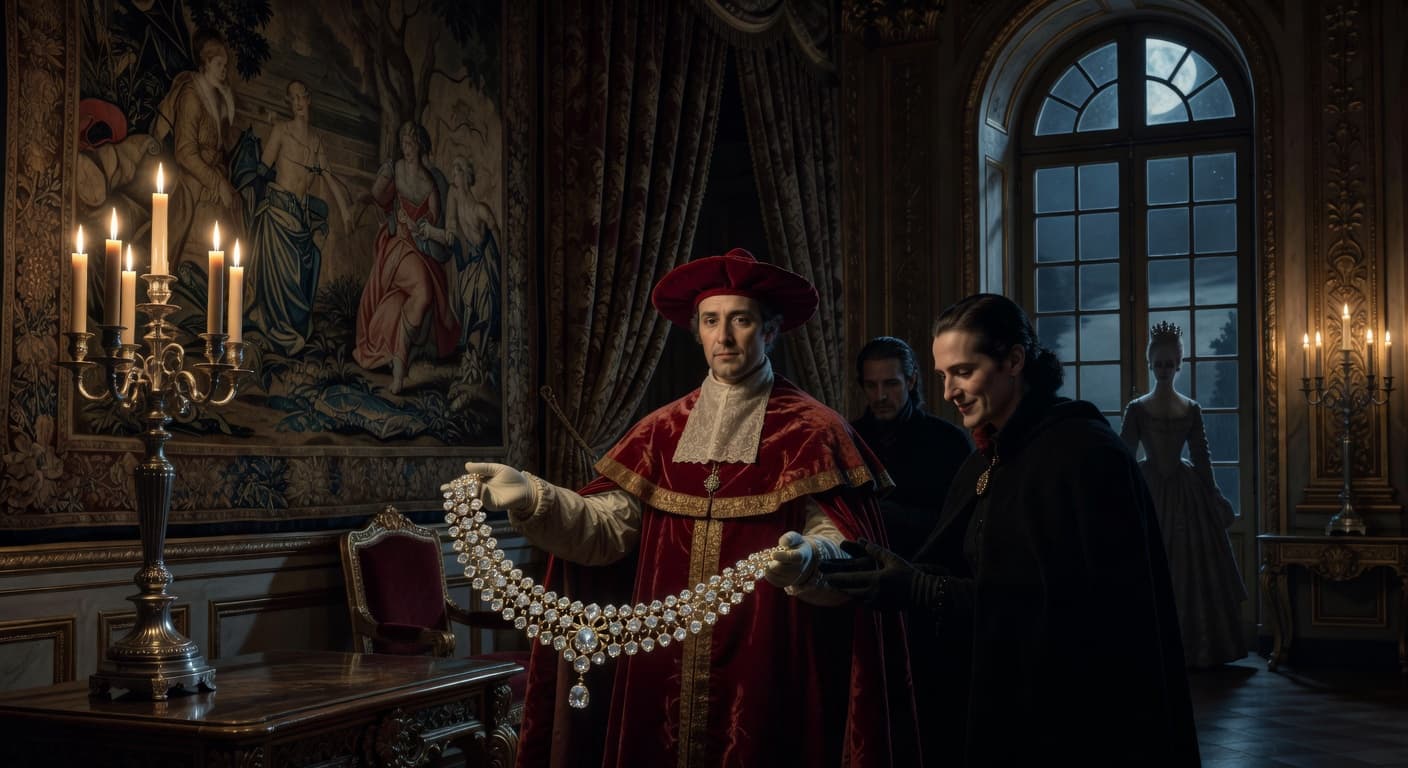
In February 1785, a cardinal of the Catholic Church stood in the palace of Versailles and handed over a necklace of 647 diamonds, weighing nearly 2,800 carats and worth 1.6 million livres, to a man claiming to be the Queen's secretary. The necklace was immediately taken to London, broken apart, and the stones sold individually. The Queen — Marie Antoinette — had never ordered the necklace, never seen it, and had no idea any of this was happening. When the jewelers Böhmer and Bassenge sent her a letter asking if she was satisfied with their product, she burned it in irritation, not knowing what it referred to.
The scheme had been engineered by Jeanne de La Motte, a woman who claimed descent from the royal House of Valois and who had managed to infiltrate the court's peripheral circles. Her targets were two men whose vanity exceeded their judgment: Cardinal Louis de Rohan, who had been excluded from Versailles by Marie Antoinette's influence and desperately wanted back into royal favor; and the jewelers, who had a necklace commissioned by Louis XV for his mistress Madame du Barry that no one had bought in ten years. La Motte convinced Rohan that the Queen secretly admired him, then arranged a moonlit meeting at Versailles in which a Paris prostitute who resembled the queen played her role for approximately fifteen minutes of darkness. Rohan, one of the most senior clerics in France, negotiated the purchase and handed over the necklace.
When the fraud was discovered, Louis XVI ordered Rohan arrested in his full cardinal's regalia in front of hundreds of witnesses in the Palace of Versailles — an extraordinary public humiliation of a prince of the Church. The trial became the sensation of the decade: forged royal letters, a prostitute impersonating a queen, a diamond necklace disassembled and scattered across London's jewelry shops. Rohan was acquitted. La Motte was convicted, sentenced to flogging and branding with a hot iron, escaped to England, and published memoirs accusing the queen of orchestrating everything.
The public believed the memoirs. Though historians now agree Marie Antoinette was entirely innocent — she had twice refused to buy the necklace — the affair cemented her reputation as a scheming, extravagant foreign queen bleeding France dry. Four years later, the revolution began. She was guillotined in 1793. The necklace never existed as a whole object for a single day.