
Back to Feed
Modern · Washington D.C., United States
Walter Freeman's Ice Pick Lobotomy: 3,000 Brain Operations With No Surgical Training
★ 8.6 / 10lobotomyneurologypsychiatrymedical-history
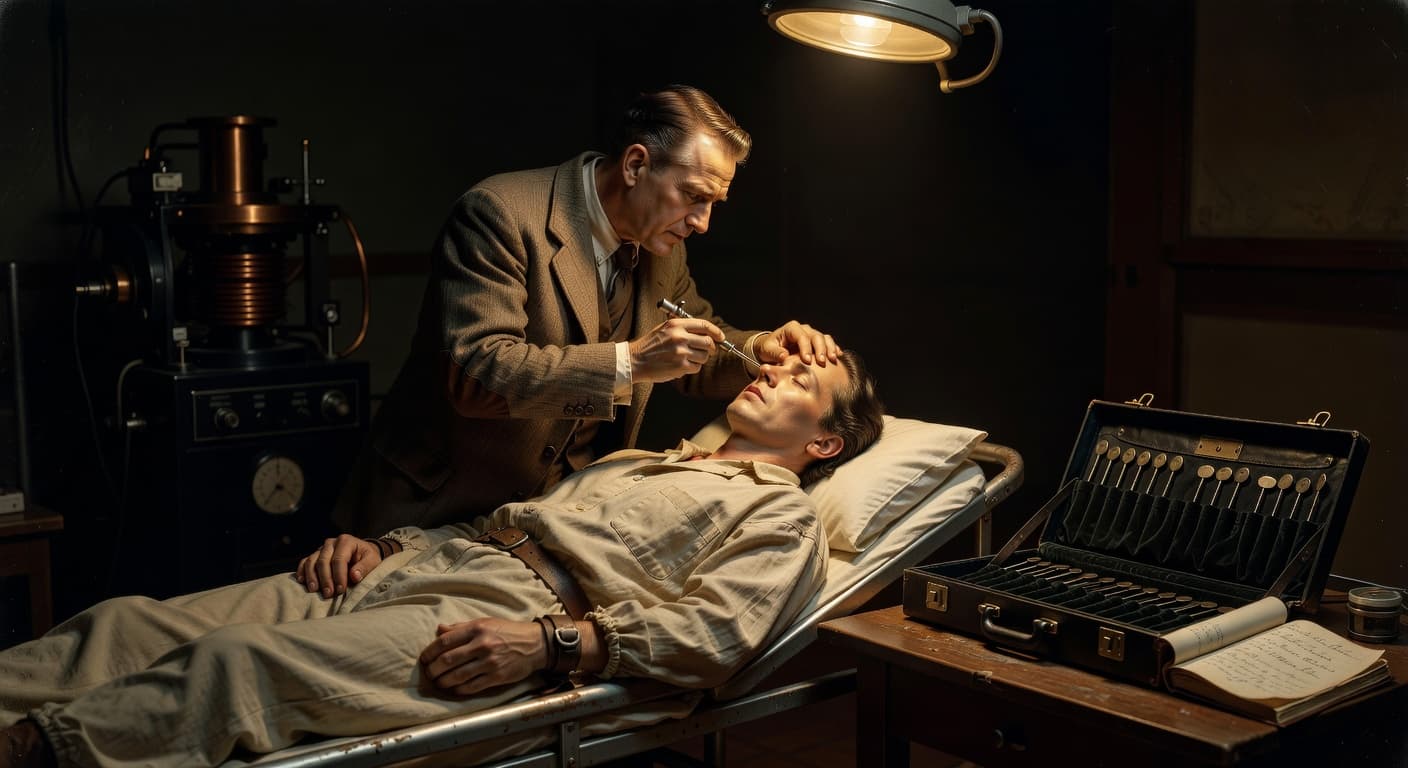
On January 17, 1946, neurologist Walter Freeman drove an ice pick from his kitchen drawer through the thin bone above a patient's eyeball and swept it back and forth to sever the connections of her frontal lobe. He had anesthetized her not with sedatives but with electroconvulsive therapy — a portable shock machine he brought to office visits in his car. The patient was a 29-year-old housewife named Sallie Ellen Ionesco. Freeman had no surgical training. He never would. Freeman had spent the preceding decade championing the prefrontal lobotomy, which he and neurosurgeon James Watts had introduced to the United States in 1936. By the mid-1940s he had grown dissatisfied with the standard procedure's complexity and cost: it required a surgeon, an operating theatre, general anesthesia, and drilling through the skull. The transorbital approach he developed — based on the work of an Italian psychiatrist — eliminated all of those barriers. Within a few years, Freeman was demonstrating the technique at state mental hospitals across the country, sometimes performing dozens in a single day. In July 1952, he performed 228 transorbital lobotomies in two weeks at a West Virginia facility the press called "Operation Ice Pick." His most famous patient was Rosemary Kennedy, sister of the future president, lobotomized at 23 in 1941 at her father's request. The operation left her permanently incapacitated and institutionalized for the remaining 64 years of her life. An estimated 490 of Freeman's roughly 3,500 patients died from the procedure. Many who survived had to be retaught to eat and use the bathroom. Relapses were common. His longtime partner James Watts left the practice in protest in 1950. Freeman performed his final surgery in February 1967, on a woman receiving her third lobotomy from him. She died of a cerebral hemorrhage. He was then banned from operating, not by law or criminal prosecution, but by the loss of hospital privileges. He died in 1972, still believing he had helped people. By then, antipsychotic medications had made the operation obsolete, and the ice pick he had first borrowed from his kitchen drawer had become a symbol of medicine at its most casually brutal.
Score Dimensions
Original Source
wikipedia.orgLike
Dislike
Skip
Save